Showing posts with label charcuterie. Show all posts

Tuesday, December 6, 2011

Gaining Momentum | Charcutepalooza, the final challenge

I am participating in Charcutepalooza, a year of meat which entails twelve monthly challenges to prepare dishes using various charcuterie techniques.  For more information about charcutepalooza, click here.  To read why I decided to partake in the meatmaking festivities, read my first post here.
It all started with the book.  I don’t even remember exactly what motivated me to I buy Ruhlman and Polcyn’s Charcuterie all those years ago.  I was in law school, a period of my life when the last thing I had time for was elaborate cooking projects.  I used to take extended study breaks, wistfully reading through it, hoping I could someday prepare even half of its recipes.  I imagined a future me, living in a farm house, raising pigs, preparing gorgeous terrines and pates, and curing fatty, ruby red salamis in my basement.  Unfortunately, that version of myself was entirely a figment of my imagination, one I never believed I could actually become.  Hung up on the infeasibility of my dream, I never seriously began using the book, except in my fantasies.  Before this year I had only attempted duck confit and a couple sporadic and failed attempts at a pancetta (unwilling to invest heavily in an experiment, I bought small quantities of low quality meats, and the final results clearly reflected my lack of initial dedication).

For this month’s challenge, we were entreated to show off to our friends and family, impress them with all the charcuterie skills we learned this year.  But something happened that I didn’t expect: I managed to impress myself as well.  At one point, while I was doing some prep work in the kitchen, one of my guests was flipping through my now stained and use-worn copy of Charcuterie and I realized that while I was certainly no expert, I was familiar with every recipe he commented on or had a question about.  Each one was something I had cooked, or at least made a variant of.  I still don’t live on a farm, I certainly don’t own any pigs, but I could prepare well more than half the recipes in that book.  And I was that much closer to my previously inconceivable dream.  It just took letting go of the end goal and taking it one challenge at a time.  I learned so much more than just how to make charcuterie.  I learned I can accomplish anything, no matter how seemingly unattainable, by taking small steps, and letting the momentum carry me forward.  And, of course having the right group of people to back me up.  So I owe so much gratitude to Cathy and Kim for bringing together this amazing and supportive group of meat lovers, to all my friends and family for putting up with, and in most cases, indulging my charcuterie obsession, and above all, to Ken for helping me with every challenge, cleaning up after me and being my co-guinea pig of each meat experiment.

As this year draws to an end, I remember vividly how I felt this time last year.  A couple years earlier I left a career path that made me miserable, and as of last year, I was still trying to figure out what I should do next.  I had ideas of where I ultimately wanted to be, but no clue how to get there.  I felt trapped, stuck in limbo between a life I happily left behind, and one I desperately wanted.  My life hasn’t changed all that much since then, except that I’m approaching the new year feeling hopeful.  Even if I don’t have my life mapped out in front of me, and no clear idea of how to get to where I want to be someday, I feel that I’ve been gathering momentum, and the potential energy moving me forward is palpable and exciting.  I know now that anything is possible and I can’t wait to see what happens next.

Ok, enough with the sappy philosophizing, let’s move on to the meat!  

My grand finale meal started with the dry cured goodies to come out of the last challenge.  The chorizo turned out to be fully edible after all, despite my fears of uneven curing and botulism.  We all ate copious amounts of it with zero adverse effects.
Dry cured chorizo, served matchstick style
The ostrich bresaola, while slightly over cured and tough, sliced to a gorgeous red color.  Ostrich has a very beefy taste so the flavor was very similar to that of a traditional bresaola.  It also had a not unpleasant metallic undertone which I attributed to the over curing, but which Ken astutely noted could be explained by the high iron content in ostrich meat. 
Ostrich bresaola
Ostrich bresaola, parmesan and parsley salad
While the meats featured in the previous dishes were prepared for an earlier challenge, the following dishes were all made with this final meal in mind.  This past Spring, for the hot smoking challenge we had made tasso, a decision I have never regretted.  However, I did experience some serious charcuterie envy when I saw all the amazing smoked salmon posts to emerge that month.  So for this final meal, I chose to prepare a smoked salmon appetizer.
Smoked salmon
Served simply on a round of good rye bread, with chives and a little chevre, this definitely satisfied the craving that has been gnawing at me since April.  
Smoked salmon on rye
For the main event, we made a variation on chicken paprikash, serving chicken thighs, confited in duck fat, over spatzle with a parika sauce.
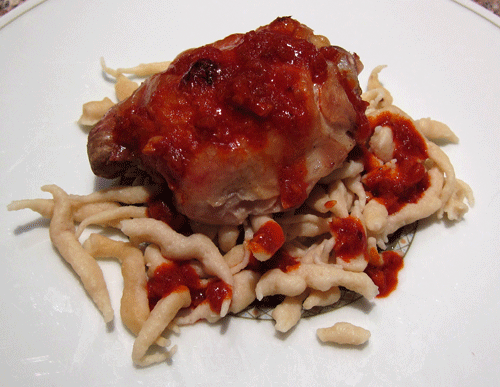
Chicken confit "paprikash" over spatzle
Kielbasa is one of my favorite sausages, so deciding to make it for this challenge was an easy choice.  We combined it with seared brussel sprouts, a side dish that ended up being everyone’s favorite dish of the night.
Kielbasa and brussel sprouts
We finished the night over a trio of stinky cheeses (to our group, the stinkier the better!), which I can take no credit for making.  However, as I basked in the glow of cocktails, wines, and pride, I thought to myself, “why not?  Maybe next year....”
Stinky cheese, and just maybe the inspiration for stinkapalooza 2012...

Saturday, October 15, 2011

The Tragic Tale of Gwen the Hen | Charcutepalooza, challenge no. 10

I am participating in Charcutepalooza, a year of meat which entails twelve monthly challenges to prepare dishes using various charcuterie techniques.  For more information about charcutepalooza, click here.  To read why I decided to partake in the meatmaking festivities, read my first post here.

charcuterie plate featuring Gwen and rabbit rillettes,
served with red pepper sauce, spiced plum jam,
hot country mustard and cornichon.
Recipes:
Gwen was prepared following the recipe found in Charcuterie, the only alterations being the use of pork belly instead of back fat and a longer cooking time which was necessary to get her up to temperature.
 
I had hoped to serve Gwen with a more ambitious sauce, but time did not permit.  We threw together this pepper sauce which is dead simple and ended up being so popular that I had to include the recipe here.  

Red Pepper Sauce
3 red bell peppers
a couple hot peppers of similar color (amount depends on desired heat)
2 tbs olive oil
1 tbs tomato paste
salt and pepper

1.  Saute diced peppers in olive oil until soft
2.  Puree peppers and work the puree through a sieve.
3.  Return puree to a hot saucepan.  Add tomato paste and cook on medium high to reduce and intensify flavors.
4.  Season to taste with salt and pepper.

Thursday, September 15, 2011

A Very Piggy Birthday | Charcutepalooza, challenge no. 9

I am participating in Charcutepalooza, a year of meat which entails twelve monthly challenges to prepare dishes using various charcuterie techniques.  For more information about charcutepalooza, click here.  To read why I decided to partake in the meatmaking festivities, read my first post here.
 
This past month, I turned 30.  My birthday always falls around labor day, which used to be a huge pain in the ass back when I had to start school around the same time.  But now that I am several years out, it has become something to look forward to (aside from the getting older part), and usually involves a full three day weekend in which to celebrate. This month I was blessed with a particularly perfect weekend - an oasis of good weather during a month of floods, rain and earthquakes.  

I planned to spend the weekend upstate with my parents, but my weekend started much earlier than expected when ken returned home from work, only a couple hours after he left, and hustled me into the car.  Forty minutes later we pulled into the site of every farm to table foodie’s wet dreams: Blue Hills at Stone Barns.  It turns out ken and my parents had been plotting this outing for weeks, and managed to keep me completely in the dark until the very last second!

 
We got there early enough to check out their farmers market, and walk around a bit before our 5:30 dinner.  This place was the platonic ideal for what every farm should be: bucolic & pristine.  And the animals were all happily doing what animals do.
And of course my favorite...  
The baby pigs were particularly adorable.  So much so that I couldn't pick just one photo to share:


After exploring the grounds, we changed into proper dinner clothing, and ate the eight course farmers feast.  It was a very good start to a very delicious and porky birthday weekend.

The next day we consumed our bounty from the blue hill farmers market which included pork hot dogs and a simple tomato salad.

On Sunday, in a combined celebration with my cousin whose birthday is one day before mine, we planned a lunch party.  I’m not a huge fan of sweets so instead of a birthday cake, I planned to serve a meat pie.  I had made Hugh Fearnley-Whittingstall’s raised pork pie back in February, and briefly considering finding a new recipe.  However, the first pie had been such a hit that I decided not to mess with what was already a very good thing.  I hoped that by repeating the same recipe, ken and I could improve our technique, and start ourselves on the path to the pork pie nirvana.  This time around, we put in more herbs (last time we had accidentally left out the thyme), and made it far enough in advance to let the gelatin set.  I also think I improved on the decorations!

 
Back in February we had procrastinated and baked the pie on the same day we planned to eat it, hence the failure to gel.  This time around we prepared the pie the Thursday before we left, to be eaten on Sunday.  (I now know why ken insisted we finish it Thursday night, rather than my original plan of doing it during the day on Friday... sneaky boy!).  I think the time made a big difference in the final product.  While delicious, the February meat pie tasted a bit like an encased meatloaf, while the filling in this one was much more reminiscent of a real pate.

The pie was served with mustard, green tomato and pearl onion pickles (recipe from the blog of charcutepalooza’s co-founder, Cathy Barrow), a german potato salad and grilled eggplants.

And finally , as a bonus, a close friend, and a loyal reader of this blog (thanks, marc!) included these apropo office supplies in his birthday gift to me, perfectly rounding out my very piggy thirtieth birthday.

Monday, August 15, 2011

Tip-to-Toe Terrine | Charcutepalooza, challenge no. 8

I am participating in Charcutepalooza, a year of meat which entails twelve monthly challenges to prepare dishes using various charcuterie techniques.  For more information about charcutepalooza, click here.  To read why I decided to partake in the meatmaking festivities, read my first post here.
The sweetest meat is closest to the bone.  Although the Chinese did not coin this aphorism, they certainly live (and eat) by it, as exemplified by my family’s eating habits.  At yum cha, my grandmother would methodically and joyfully (gluttony is a trait that runs rampant up and down my bloodlines) reduce spare ribs and chicken or duck feet into a neat, ever-expanding pile of delicate white bones, clear of all meat and cartilage.  At an early age, I too was taught to tear flesh off bones and crush shells between my teeth to get at the “best” bits, which were always those hardest to obtain.  Once, in my grade school cafeteria, I was mortified when my dining companion commented on how funny it was that I kept eating chicken wings long after the meat was gone.  Mortified, because in third grade I didn’t want to be “different” (who does?), but I also couldn’t understand how someone with fully functional eyesight could not see the very visible scraps of meat still attached to the wing bones.

To a very small extent this embarrassment has survived into my adulthood.  When served bone-in meat dishes at fancy restaurants, I often ask to get the bone to-go for my non-existent dog, so I can gnaw at it in the privacy of my own home.  Other than that one lapse, I am for the most part proud of my ability to get at every tasty tidbit of meat on a bone and every succulent morsel out of a lobster.  Like learning to make charcuterie and to appreciate offal, eating every scrap of meat is one of the ways I show respect for the animals that die for my enjoyment and sustenance.

I suspect the Chinese love affair with the hard to eat bits originated in frugality as much as in respect.  Regardless of the source of this obsession, its influence can be seen in all Chinese cuisine from street food to banquets.  There are some Chinese delicacies, chicken feet or fish heads for example, that are impossible to finish eating without a mound of soiled and shredded paper napkins piling up next to your plate.  The few bites that you work so hard to get are incredibly delicious and usually more than worth the entire undertaking.  But sometimes I’d prefer to walk away from a Chinese meal without grease stains on my clothing and animal bits in my hair.  For this month’s terrine challenge I chose to turn a traditionally messy Chinese dish, jellied pig feet, into easy-to-eat, slice-and-serve presentation.

At the butcher, in addition to pig feet, I picked up a tongue, two pig ears and, as suggested by Cathy Barrow a pork shank for added meatiness.  I brined the meats for 24 hours as called for in the Charcuterie head cheese recipe, but chose to omit the pink salt.  After blanching the meats to rid them of impurities, I put them in a pot to simmer with onion, ginger, garlic, star anise, several tablespoons of both dark soy and light soy, and water to cover.  This concoction is very loosely based on the recipe for Chinese-style pig’s trotters in The River Cottage Cookbook.  At this stage I was careful to avoid over-seasoning the liquid, knowing it may need to be reduced at a later time.
clearly our "big" pot wasn't big enough - I finished it all up in a stockpot
After about three to four hours on the stove, when the meat was tender and the ears offered only the mildest resistance when pierced with a chopstick, I removed the pieces and strained the liquid, which should have absorbed enough gelatin from the pig skin and cartilage to bind my terrine together.
Last month, I had written about how sausage making was finally coming more easily to me.  I think my arrogance seriously angered the charcuterie gods, who decided this month to make me pay.  My memory of everything after the meat finished cooking is hazy.  I remember it was very very very hot that day.  I remember shredding meat off the pig feet and realizing why glue is made from animal hooves.  I remember ken coming home from work to find every surface in the kitchen - walls, appliances, pots, pans - sticky with the gelatin which seemed to have found its way into everything except into my cooking liquid.  The damned thing would not gel.

Ken somehow wrestled me down off the edge of depression and convinced me to put the terrine aside completely until the morning (and he cleaned! Once again, I am struck by how lucky I am to have him).  The charcuterie gods must have been satisfied with my penance, because everything pulled together the next day.  After reducing the broth by about a third, it gelled up nicely.  From there, the process was straightforward, if a bit messy.  I combined the shredded trotter and shank meat with slices of pig ear and diced tongue and pressed the mixture into a terrine.  I kept one ear intact so I could form a decorative stripe of pig ear through the center of the terrine.  Once the stock was poured over the meat, the entire thing was weighted and put in the fridge until ready to be unmolded and served.
Since presentation was a big part of this months challenge, I wanted an appealing spread of accompaniments.  Barbara Tropp’s The Modern Art of Chinese Cooking opens with a chapter on the Philosophy of Chinese Cooking in which she describes an overriding characteristic of Chinese cooking to be the “conspicuous juxtaposition [of]...flavors, textures, colors, food types, and cooking methods.”  It was with this principle in mind that I chose the dishes which would accompany the terrine.  From Tropp’s book*, I made fire-dried walnuts, which were crunchy, meaty, and slightly sweet and bell pepper pickles with vibrant colors that contrasted their subtle sweet-soy seasoning.  

*I see the irony that my Chinese recipes come largely from Western writers.  I have a theory which I won’t go into today, that often the best culture-based cookbooks come from outsiders to that culture.  
adorable mini-bell peppers I found at the greenmarket
Szechuan cucumber pickles, from Su-Huei Huang’s Chinese Cuisine contributed a bold spicy flavor with bright vinegar overtones.  And finally, the meal was rounded out with stir-fried bitter melon.  All, of course, served over a bowl of steaming white rice.

The terrine was good, although I’d do some things differently next time I make it.  For one, the gelatin itself needed much more robust seasoning.  I was so worried about adding too much soy the first day, that I overcompensated, and ended up with a slightly bland binder.  Also, next time I would probably leave out the ears.  The crunch was slightly disconcerting (which is odd because I am quite fond of another Chinese dish, pressed pig ear terrine), and there was a slight off flavor to it which I couldn’t help but associate with ear wax.  If I ever get around to making an actual headcheese, I will need to find something more palatable to do with the ears.  These complaints are just nitpicking, though.  Altogether this was a nicely balanced meal, where each component complimented the others.  I’d never had a terrine over rice before, but found it to be a very pleasant combination.  While mostly holding its shape, the gelatin melted just enough to season the rice beneath it.  The dish was complex in flavors and textures, and perfectly showcased the terrine.

unfortunately it didn't slice as cleanly as I'd hoped

Friday, July 15, 2011

How to half-ass a weisswurst | Charcutepalooza, challenge no. 7

I am participating in Charcutepalooza, a year of meat which entails twelve monthly challenges to prepare dishes using various charcuterie techniques.  For more information about charcutepalooza, click here.  To read why I decided to partake in the meatmaking festivities, read my first post here.
Usually I approach my monthly charcutepalooza challenge like a celebration, with days of planning and eager anticipation.  This month it was hard to muster up a similar level of enthusiasm.  Not that I was unhappy with the challenge.  On the contrary, I had been anxiously awaiting the emulsified sausage challenge, for which I had planned to create my own version of the Chang Dog, completely from scratch with homemade buns, kimchee, bacon, and of course the hot dog.  But when the challenge finally rolled around my heart wasn’t in it.  With a big trip to Maine approaching all I could think about was seafood.  For the first time since this year of meat started, I just wasn’t craving any.
 
Beside all that, finding time to get upstate where we have access to the smoker, which we needed to make hot dogs, was simply not feasible.  Not only was I occupied with all the normal things that need to be taken care of in the weeks before traveling, but ken managed to come down with a bad three week long summer cold which left him for all practical purposes, incapacitated.  I never realized how much ken does to make my life easier and better until he went out of commission, and everything just started falling apart.
At first I considered skipping this challenge altogether, but couldn’t justify it to myself as we had all the equipment necessary plus about a lifetime supply of hog casings in the freezer.  We chose to make weisswurst mostly because it was simple enough to do in the limited time we had, and mild tasting enough for ken to eat on a queasy stomach.  So on a day that ken was feeling well enough to help out, and I had a few free hours to kill before running out to meet some people at a party (gay pride - this year you couldn’t live in ny and not celebrate!), we banged out three pounds of weisswurst.

Unlike the fresh sausages we made last month, the meat in emulsified sausages is ground twice, the second time with ice, and then whipped into a stiff paste before being stuffed into a casing.  Maintaining the temperature is extra crucial because the meat is so extensively manhandled.  Otherwise, the process is pretty much identical.  And the practice we had making the fresh sausages paid off - we had a surprisingly easy time making these weisswurst.  It still took a lot of time, but everything felt like it came together rather seamlessly - even the pastry bag technique felt less onerous.  I guess it’s really true what they say that doing is the best form of learning. This may be an obvious lesson to most, but I’ve always been the type to over-think any potential undertaking.  I had owned and sporadically read through Charcuterie for years, but all that reading and learning didn’t teach me how to make sausages.  It was only by using the grinder, and stuffing sausages regularly the past couple months that I finally started to get the hang of it.

That’s not to say that we are experts, or even particularly good yet.  I mean, check out the air pockets in the casing!  But the process is finally feeling a little more routine, and less like a huge and unpredictable endeavor.

Once, years ago, after cooking a huge multi-course meal for my family, I asked my grandmother what she thought.  Her reply was that it was good but that I was a “fun cook”.  At the time, I was confused, and probably slightly offended, but I now understand what she meant.  Any reasonably skilled cook can make a great meal when it is for an event or a meal that they are excited about planning and preparing.  The true test of a good cook is how well they can put together a meal when they are tired or cranky, or would rather be doing other things.  Although we’ve made sausages successfully a couple times now, it took making them when neither of us were at all excited about eating them (ken ate reheated soup that night and I went out), to finally start feeling proficient at it.  

I thought I could muster up the enthusiasm to make homemade pretzels and mustard to go with them the next day, but after waking up with the worst hangover in existence, it was clear that was not going to be an option.  So without further ado, our charcutepalooza dish: weisswurst and, um, sliced bread.

I sincerely hope a recipe is not necessary.


And just so I’m not a total downer, here are some of the things we were actually excited about this past month:
lobster roll that we ate on our way out - first meal in Maine!
the view from our home away from home
fox living on premises, who made an appearance every day
around cocktail hour

learning how to humanely dispatch a lobster
cooking shellfish on the beach
 

fried clams that we ate on our way home - last meal in Maine
With a headcheese challenge on the way, I can assure you, I’ll have more enthusiasm for next month’s charcutepalooza post!


P.S. If anyone knows how to better control the spaces between pictures in blogger, please please please let me know.

Tuesday, March 15, 2011

Corned Beef and Tongue | Charcutepalooza, challenge no. 3


Growing up in new york city, my childhood was punctuated with outings to the second avenue deli. Although my family is half chinese and half eastern european jewish, chinese food was disproportionately prominent in my diet. So trips to the deli were where I first became familiar with and learned to love the cuisine of my other half. When the deli closed down in 2006, after surviving the still unsolved murder of the long time owner, and having been in business for just over half a century, it was somewhat devastating. Even though it has since reopened in Murray Hill, I still feel a little sick every time I pass the shiny new chase bank now located in its original location on second Ave and 10th street. There is a brief history of the deli on the restaurants website, but for a more in depth and fascinating look at the man behind the deli, check out this article.

Much as I loved the food, these visits were also the source of anxiety for me. I was terrified of one waitress, who was visibly irritated and impatient with any kind of indecision, something that always plagued my meals there. The sandwiches, thinly sliced fatty meats towering between two thin slices of rye bread, are of course the star of the deli experience. But I’ve always been a soup lover, and the chicken in the pot - clear flavorful broth, seasoned with dill and full of small square noodles, ladled over half a chicken and a matzoh ball, was also a huge temptation to me. So usually I’d waiver between the soup and a corned beef sandwich until the last possible minute, when under her withering glare, I’d panic and order whichever I happened to look at first on the menu.


Now that I’m older, I’m not any more decisive. Therefore my first thought when the March charcutepalooza brining challenge was announced was that I would make deli sandwiches and serve them alongside bowls of matzoh ball soup, waistline be damned. Fortunately I had the good sense to scrap that idea after seeing the amount of meat we procured from the butcher - close to six and a half pounds all together (four lbs of brisket, two and a half of tongue). That seemed like more than enough to feed a party of four, even after taking into account the very healthy appetites of all involved. If common sense hadn’t stepped in, practicality would have put an end to my soup plans, as the tubs of brining meat left so little free space in the fridge that any additional cooking would be near impossible.


(I'm afraid I need to apologize in advance for the following picture. There's really no way to photograph a raw tongue without making it look obscene:)


After brining for four days, followed by a slow simmer which made me salivate all day, the brisket came out beautifully, fatty and flavorful. My complaints with the tongue are minimal. Based on the coloring, I believe it should have brined for more time. Also, it was a little bit too chewy, and should have been cooked longer. The next day though, after a couple more hours of cooking, the tongue was perfectly tender.


To accompany the meat, we made mustard following Hank Shaw's recipe from his blog Hunter Angler Gardener Cook, and russian dressing. All between two slices of Ken’s freshly baked rye bread, these sandwiches were top notch. The soup wasn’t even missed.


One added bonus of our family trips to the deli was that this was one of the few times I was allowed to drink soda. On each visit I would savor a can of Dr. Brown’s Black Cherry soda, while eyeing the similar green cans - the Cel-Ray soda with revulsion. Celery flavored soda would probably seem a little odd to most people, but to the celery-hater I once was, the idea seemed particularly vile.

Since then, my feelings towards celery have changed drastically. Ironically it was another self-proclaimed celery hater who instigated my conversion. Long before I “read” food blogs, I was reading Carol Blymire’s. In fact her former blog, French Laundry at Home is probably the start of what has since become an obsession with online food writing. It was this particular post, regarding peeling celery which caused my 100% reversal on the subject. After reading the post, I knew I had to try it out myself. The first thing I noticed was the smell which becomes more distinct during the peeling process. Celery has a light, refreshing, and almost floral scent which lingers on your fingers long after the celery has been prepped and put aside. And the celery itself, usually just a watery stringy stem which made me gag, suddenly became crisp and refreshing if still somewhat bland.

I have the tendency to get obsessed with things, and this discovery was no exception. I hopped on the celery peeling bandwagon with near evangelical enthusiasm. During that time I could not be in the same room as celery without looking for a peeler. I preached over crudite, was indignant at every bloody mary garnished with its signature stalk of (unpeeled!) celery. I was completely insufferable, and am pretty thankful to have any friends left - one in particular (you know who you are...). So my obsession since then has cooled, but my fondness for celery has remained. Therefore, when I decided to come up with an accompaniment for my deli sandwiches, my thoughts immediately turned to that increasingly appealing lime green can of Dr. Brown's soda.


I decided to make my own celery soda, by slightly adapting this Alton Brown recipe. The primary change being the addition of fresh celery in order to get more of the lovely fresh celery fragrance I became so infatuated with. The result had a startlingly distinct celery flavor, refreshing if a little odd to an unfamiliar palate. However, everyone who tried it found the syrup to be overly sweet and so the recipe below is adjusted accordingly. We use the same ratio: equal parts sugar to water, for ginger syrup to make homemade ginger ale and cocktails, and find that the proportion allows you to add enough syrup to get a strong flavor without too much sweetness. I can see this celery syrup working well in a light summery cocktails as well.

Homemade Celery Soda
adapted from Alton Brown’s recipe on Food Network

Ingredients:
1 cup sugar
1 cup water
2 tablespoon ground celery seed
3-4 stalks of celery, roughly chopped (peeling not necessary!)
seltzer

1. In a saucepan, over medium heat, dissolve the sugar into the water.
2. Once fully dissolved, remove from heat, and add celery seed and celery chunks. Muddle the celery lightly to release their juices. Allow to steep for an hour.
3. Strain the syrup through a fine mesh strainer. If you have the patience and the inclination, strain again through a coffee filter (while still hot) to ensure no grainy celery seeds in your final product.
4. Put a couple tablespoons of celery syrup in a glass with ice. Fill with seltzer, and stir. Adjust syrup according to your own taste.

Note: make sure the seltzer you use is highly carbonated. The one we bought initially wasn’t nearly fizzy enough, and it made a huge difference to the final product.